
Our services
Cognitive Behavioral Therapy (CBT)
CBT is a proactive treatment recommended for many mental health conditions and life challenges and is appropriate for most individuals and couples.
ACCEPTING NEW CLIENTS!

Pharmacotherapy
Medications are indicated for certain psychiatric disorders and may be used in conjunction with other treatments or on their own, depending on the individual and the disorder.
Our practice does NOT prescribe any controlled substances.
We are NOT currently accepting new patients for medication management.
Coaching
Coaching services may be used for those seeking assistance with a variety of life challenges and personal or professional goals.
Coaching services are offered on a case-by-case basis, please inquire if interested.
This isn’t traditional talk therapy. There are no couches here.
Cognitive Behavioral Therapy (CBT) is a collaborative, structured, time-limited, solution-focused, action-oriented approach that equips you with the tools needed to make meaningful and lasting change in weeks to months, not years. In contrast, traditional talk therapy is unstructured, insight-oriented, and measures treatment time in years.
CBT incorporates both cognitive and behavioral approaches to mental health. We practice CBT with a strong behavioral emphasis because that is what the scientific evidence indicates holds the greatest impact across a range of conditions and, critically, has a theoretical basis that is fully compatible with modern scientific understandings and pharmacological approaches to treatment.
Understanding CBT
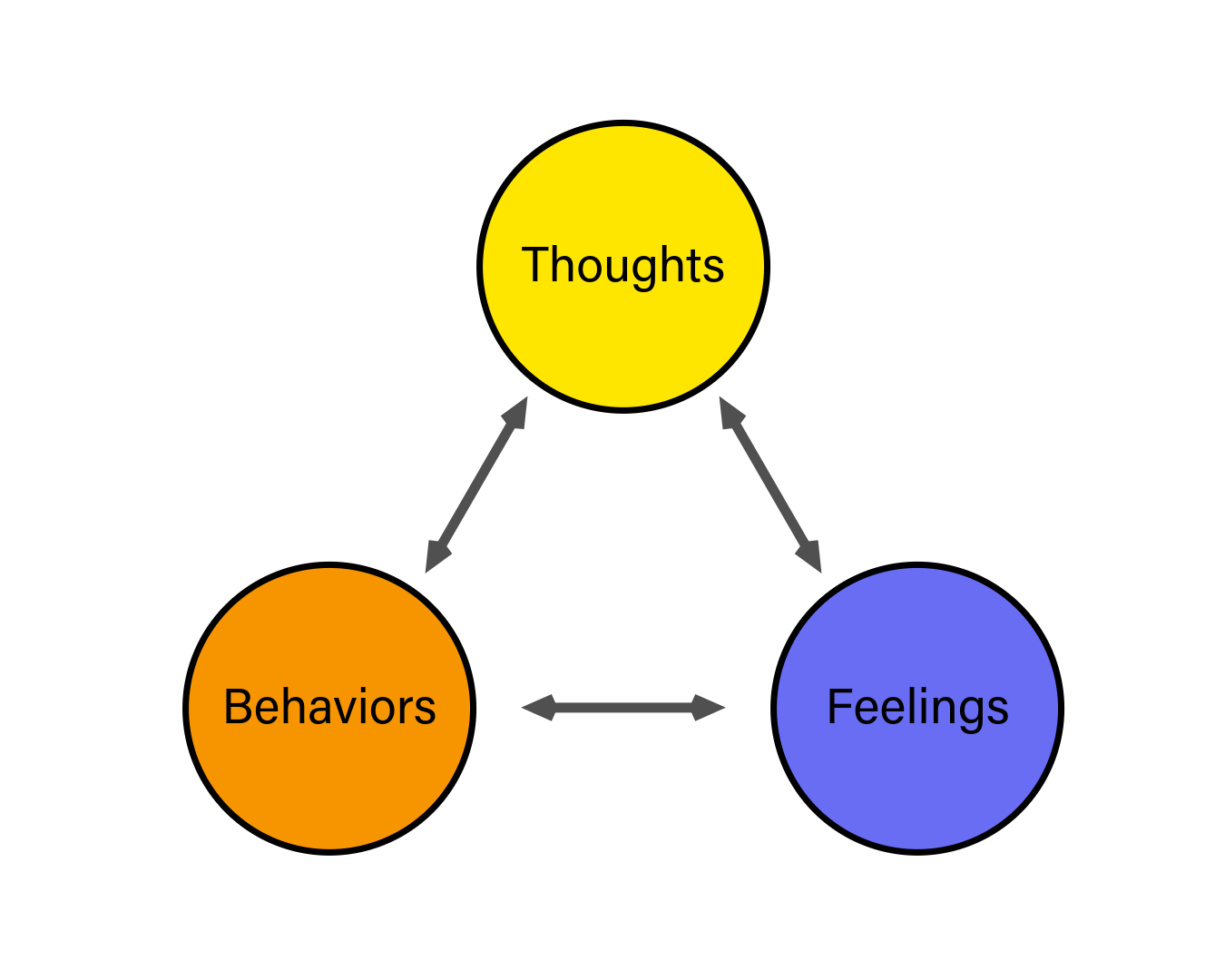
CBT understands thoughts, feelings, and behaviors to be connected through a feedback loop. Changes to one or more of these causes a chain reaction in the others. As with other modern approaches to mental health, CBT views the origins of dysfunction/disruption in any of these three to lie in the three P’s: Predisposing, Precipitating, and Perpetuating factors.
CBT targets intervention towards the behaviors, thoughts, and emotional responses that drive perpetuation of dysfunction, distress, and illness. As we can’t change predisposing factors and we can’t undo the precipitating events, CBT focuses on the present to address perpetuating factors and bring about change in thoughts, feelings, and behaviors.
Learn More about the three p’s
-
Predisposing Factors: underlying vulnerabilities or traits that influence risk for developing a mental health condition, largely driven by genetics, personality traits, and significant environmental factors like prenatal exposure to alcohol. These are core features of who we are and vary from individual to individual: we all have them, but everyone is different.
-
Precipitating Factors: events, circumstances, or stressors that build on predisposing factors to challenge resilience and lead to dysfunction and/ distress. Examples include: illness, relationship turmoil, traumatic events, and difficult life transitions.
-
Perpetuating Factors: behaviors, thoughts, and environmental conditions, arising from precipitating factors and riding on predisposing characteristics, that maintain dysfunction over time. These vary by individual and disorder/challenge, but might include anxious avoidance, depressive withdrawal, compulsive behaviors, negative automatic self-talk, and poor communication in a relationship. These often start as coping mechanisms but end up prolonging problems or making them worse.
What does CBT look like in practice?
A course of CBT usually spans about 12-20 sessions in most cases, though each individual’s treatment is tailored to their specific needs.
Sessions typically occur weekly, though they may be spaced out more later in the course of therapy. Each session is generally 50 min in length and is structured. The structure of each session is governed by an agenda, the details of which are collaboratively determined.
Homework, or between session skills practice, is utilized to ensure that progress occurs outside of session and not just for 50 min once per week. Homework also serves to help clients develop mastery of skills in the real world across a variety of contexts. Repetition is critical to new learning and homework provides a structured framework for this.
A typical session structure:
Check-in
Brief review of progress and challenges encountered since last session
Agenda Setting
Prioritize topics this session
Homework Review
Review prior assignment outcomes and barriers
Main Intervention
Cognitive, behavioral, or exposure work on agenda items
Summary and Homework
Consolidate learning; assign next practice
Feedback and Conclusion
Client feedback for therapist and conclusion of session
Cognitive Behavioral Therapy for Insomnia (CBT-I)
Cognitive Behavioral Therapy for Insomnia (CBT-I) is a structured, evidence-based treatment that addresses the thoughts, habits, and patterns that keep sleep problems going. It uses practical strategies to strengthen the connection between bed and sleep, stabilize the sleep schedule, reduce time spent awake in bed, and ease anxiety about sleep. CBT-I is considered the first-line treatment for chronic insomnia and can provide lasting improvement without relying on sleep medication.
Treatment is focused on this single issue and typically runs 6-8 sessions.
cognitive Behavioral Therapy for Nightmares (CBT-N)
Cognitive Behavioral Therapy for Nightmares (CBT-N) is a brief, evidence-based treatment that helps reduce the frequency and intensity of recurring nightmares. It uses techniques such as imagery rehearsal and rescripting to change distressing dream patterns, reduce fear surrounding sleep, and improve sleep quality.
Treatment is focused on this single issue and typically runs 6 sessions.